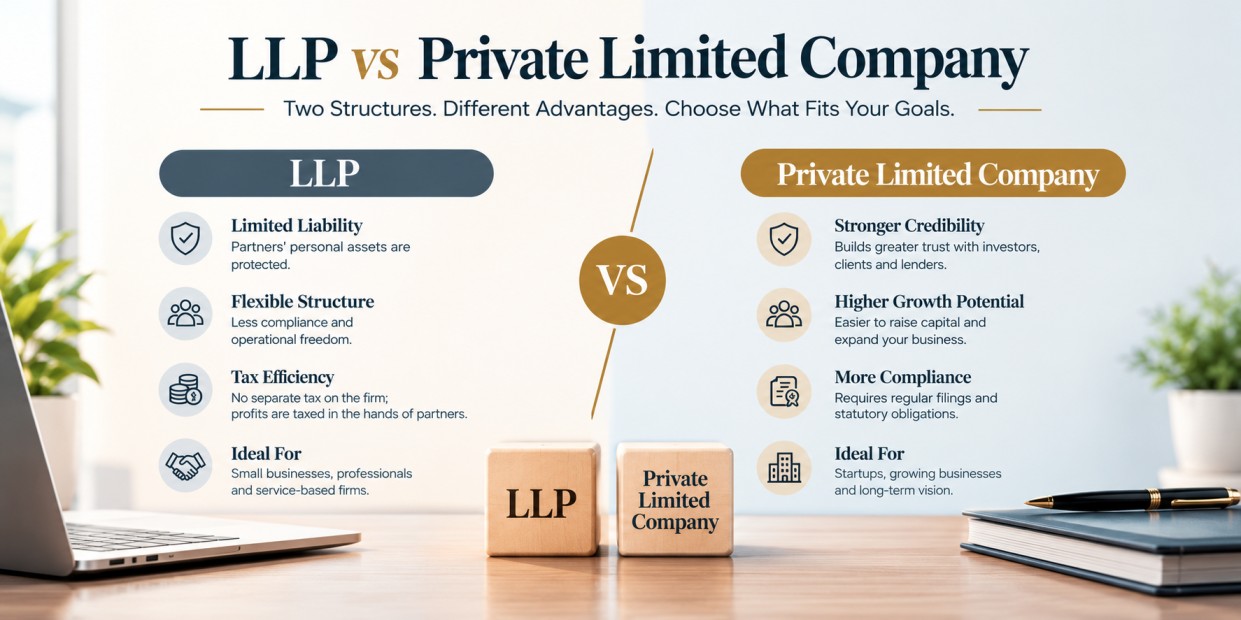
LLP vs Private Limited Company: Which Business Structure Should You Choose?
Choosing the right legal structure is one of the most important decisions when starting a business in India. Two popular options for entrepreneurs and startups are a Limited Liability Partnership (LLP) and a Private Limited Company.
Both structures provide limited liability protection, but they differ in areas such as ownership, management, compliance, taxation, investment opportunities, and business flexibility.
If you are confused about LLP vs Private Limited Company, this guide explains the major differences to help you understand which structure may suit your business requirements.
What Is an LLP?
A Limited Liability Partnership (LLP) is a separate legal entity registered under the Limited Liability Partnership Act, 2008.
An LLP combines certain features of a partnership with limited liability protection. The partners can generally manage the business according to the terms of their LLP agreement.
An LLP can be suitable for professional businesses, consulting firms, service providers, and businesses where the founders want a flexible management structure with limited liability.
What Is a Private Limited Company?
A Private Limited Company is a separate legal entity incorporated under the Companies Act, 2013.
The ownership of a company is represented through shares, and the company is managed by its directors in accordance with applicable law and its constitutional documents.
Private Limited Companies are commonly used by startups and businesses that want a structured ownership model and may plan to raise external investment or expand their operations.
LLP vs Private Limited Company: Key Differences
1. Minimum Members
An LLP generally requires at least two partners.
A Private Limited Company generally requires at least two members/shareholders and two directors, subject to applicable legal requirements.
2. Ownership Structure
In an LLP, ownership and rights are generally determined through the LLP agreement.
In a Private Limited Company, ownership is represented through shares. Shareholders hold shares in the company, while directors are responsible for managing the company's affairs.
3. Management
LLPs generally offer greater flexibility in deciding how partners will manage the business through the LLP agreement.
A Private Limited Company has a more structured management system involving shareholders and directors, along with statutory corporate procedures.
4. Liability Protection
Both LLPs and Private Limited Companies generally provide limited liability protection to their owners or partners, subject to applicable law and circumstances.
This means the business is treated as a separate legal entity, and the liability of partners or shareholders is generally limited according to the applicable legal framework.
5. Compliance Requirements
Compliance requirements differ between an LLP and a Private Limited Company.
Private Limited Companies generally have more extensive corporate compliance obligations, which can include maintaining statutory records, conducting required meetings, and filing applicable annual returns and financial statements.
LLPs also have annual filing and accounting requirements, but their compliance framework is generally different from that of companies.
The actual requirements depend on factors such as business activities, turnover, contribution, transactions, employees, and applicable regulations.
6. Raising External Investment
A Private Limited Company can be more suitable where founders intend to bring in investors through equity participation because ownership is structured through shares.
An LLP can also receive investment or funding through appropriate arrangements, but its structure is different from a company and may not be suitable for every type of investor or funding arrangement.
Entrepreneurs planning venture capital or institutional investment should carefully evaluate the structure before incorporation.
7. Profit Distribution
In an LLP, the partners can generally agree on the sharing of profits and losses through the LLP agreement.
In a Private Limited Company, profits may be distributed to shareholders as dividends subject to applicable legal requirements and the company's financial position.
8. Continuity
Both LLPs and Private Limited Companies have a separate legal identity and can generally continue despite changes in their partners, shareholders, or management, subject to applicable law.
This provides continuity beyond the involvement of individual founders.
LLP vs Private Limited Company: Comparison
|
Factor |
LLP |
Private Limited Company |
|
Governing Law |
LLP Act, 2008 |
Companies Act, 2013 |
|
Minimum Members |
2 Partners |
2 Shareholders |
|
Management |
Partners |
Board of Directors |
|
Ownership |
Partnership interest |
Shares |
|
Liability |
Generally limited |
Generally limited |
|
Compliance |
Generally lower in structure |
Generally more extensive |
|
External Investment |
Possible, structure-dependent |
Structured equity model |
|
Profit Sharing |
LLP agreement |
Dividends, subject to law |
|
Suitable For |
Professional/service businesses and flexible partnerships |
Startups, growing businesses and investment-oriented ventures |
Advantages of an LLP
An LLP may be suitable for entrepreneurs who want:
- Limited liability protection
- A flexible management arrangement
- A partnership-based ownership model
- Relatively simpler corporate formalities compared with a company
- A suitable structure for professional or service-oriented businesses
However, the actual compliance and tax position should be evaluated based on the specific business.
Advantages of a Private Limited Company
A Private Limited Company may be considered by businesses that want:
- A formal corporate structure
- Share-based ownership
- A framework for bringing in shareholders
- Potential external investment
- A structured management system
- A business structure suitable for long-term expansion
It can be particularly relevant for startups that expect to expand their ownership base or seek equity-based investment.
LLP or Private Limited Company: Which Is Suitable for a Startup?
There is no single structure that is appropriate for every startup.
An LLP may be considered when the founders want flexibility, intend to operate through a partner-based structure, and do not currently require a conventional equity investment model.
A Private Limited Company may be considered when founders want share-based ownership, plan to bring in investors, or expect the business to scale through an organized corporate structure.
The decision should be based on the startup's business model, number of founders, funding plans, compliance capacity, ownership requirements, and long-term objectives.
Factors to Consider Before Choosing
Before registering an LLP or Private Limited Company, entrepreneurs should consider:
Business Activity
Certain businesses may have specific regulatory or licensing requirements. The nature of your business should be considered before selecting the structure.
Funding Requirements
If you expect to raise equity investment, consider how ownership and investment will be structured.
Compliance Capacity
Companies generally have more formal corporate compliance requirements. Founders should consider whether they are prepared to maintain the necessary records and filings.
Ownership and Control
If multiple founders are involved, determine how ownership, decision-making, profit sharing, and responsibilities will be divided.
Future Expansion
Think about where you expect the business to be in the next few years. A structure that works for a small professional business may not necessarily be ideal for a startup planning significant external investment.
Can an LLP Be Converted Into a Private Limited Company?
Depending on the circumstances and applicable legal provisions, an LLP may be converted or restructured into another business form through the applicable legal process.
However, conversion can involve documentation, regulatory requirements, tax considerations, and other consequences. Professional advice should be obtained before deciding to change the business structure.
LLP vs Private Limited Company: Tax Considerations
Tax treatment is another important factor when choosing a business structure.
LLPs and companies are subject to different tax and compliance frameworks. The applicable tax liability can depend on the nature of the business, income, deductions, transactions, and changes in tax laws.
Therefore, entrepreneurs should not choose a structure based solely on the headline tax rate. The overall tax, compliance, operational, and investment implications should be evaluated together.
Common Mistakes Entrepreneurs Should Avoid
Choosing a Structure Only Because It Is Cheaper
Initial registration or compliance costs should not be the only consideration. Future investment, taxation, compliance, and expansion plans are equally important.
Ignoring Future Funding Plans
If you expect to raise equity investment later, consider the implications of selecting an LLP at the beginning.
Not Defining Founder Responsibilities
Multiple founders should clearly establish ownership, responsibilities, decision-making rights, and profit-sharing arrangements.
Ignoring Annual Compliance
After registration, both LLPs and companies have continuing legal and compliance obligations. Missing applicable filings can result in penalties and other consequences.
Conclusion
The choice between an LLP and a Private Limited Company depends on your business objectives rather than simply choosing the structure with fewer formalities.
An LLP can provide a flexible partnership-based structure with limited liability, while a Private Limited Company provides a more formal share-based corporate structure that can be suitable for startups planning expansion and external investment.
Before registering your business, consider your ownership structure, funding plans, business activities, compliance requirements, taxation, and long-term goals.
If you need assistance understanding LLP Registration or Private Limited Company Registration in India, ComplyGuruPro can help you understand the applicable process, documentation, and compliance requirements.
Contact ComplyGuruPro at ndiacomplyease@gmail.com to discuss your business registration requirements.